The problem
I got tired of walking stakeholders through dense ops tools on a carrier called “Test Plan A.” People disengage. They can’t hold a multi-LOB story in their head. And you still can’t put real payer data in a demo.
We needed a shared fictional universe: plan names, LOBs, member journeys, and plan documents that felt real. Same invented world for member portals, the CIM lab, Iris fixtures, and wiki plan docs.
Research
- Demo debriefs with stakeholders
- Persona / LOB story mapping
- Ethics review (fictional banners)
- Generator package alignment
- End-to-end walkthrough rehearsals
This wasn’t classic office shadowing. It was watching demos die when the story world was thin. I mapped the LOBs we actually needed (multi-LOB medical, Oregon-style CCO, stand-alone dental), aligned them to Data Generator persona packages, and insisted on always-on “fictional plan” banners so ethics stayed boringly clear.
What I owned
Brand systems, marketing IA, portal flows, demo ethics, and the linkage from site personas to generator packages and wiki plan docs. Each site is a modern Vue front end you can walk through live (and, where needed, deploy static / CDK).
Approach
One invented plan world—generator data, FHIR API, portals, CIM lab, and wiki docs all tell the same story.
Hypothesis: if demos share one invented world, people stay in the story from member portal to ops tool. Goal: complete end-to-end workflows, not disconnected mock screens.
- Data Generator persona DAGs (
pchp,camas_cco,timberline) produce members, networks, claims, auths, appeals, and connector packs. - FHIR-based API maps that output so member portals and the CIM lab share one source of truth for claims, coverage, and member context.
- Ayin Wiki holds synthetic plan documents (EOCs, SBCs, CCO narratives, dental schedules) for humans and agents.
- These websites are the front doors: marketing + portal so a demo can start as “I’m a Pacific Crest / Camas / Timberline member” before landing in ops tools.
End-to-end demo loop
Typical walkthrough: pick a persona on a plan site → portal dashboard and claims pull from the FHIR API → those resources resolve to generator rows → open the same member or claim in the CIM lab for ops density. Marketing pages stay story; portals and CIM are live clients of the synthetic integration layer.
Three faces of the same program
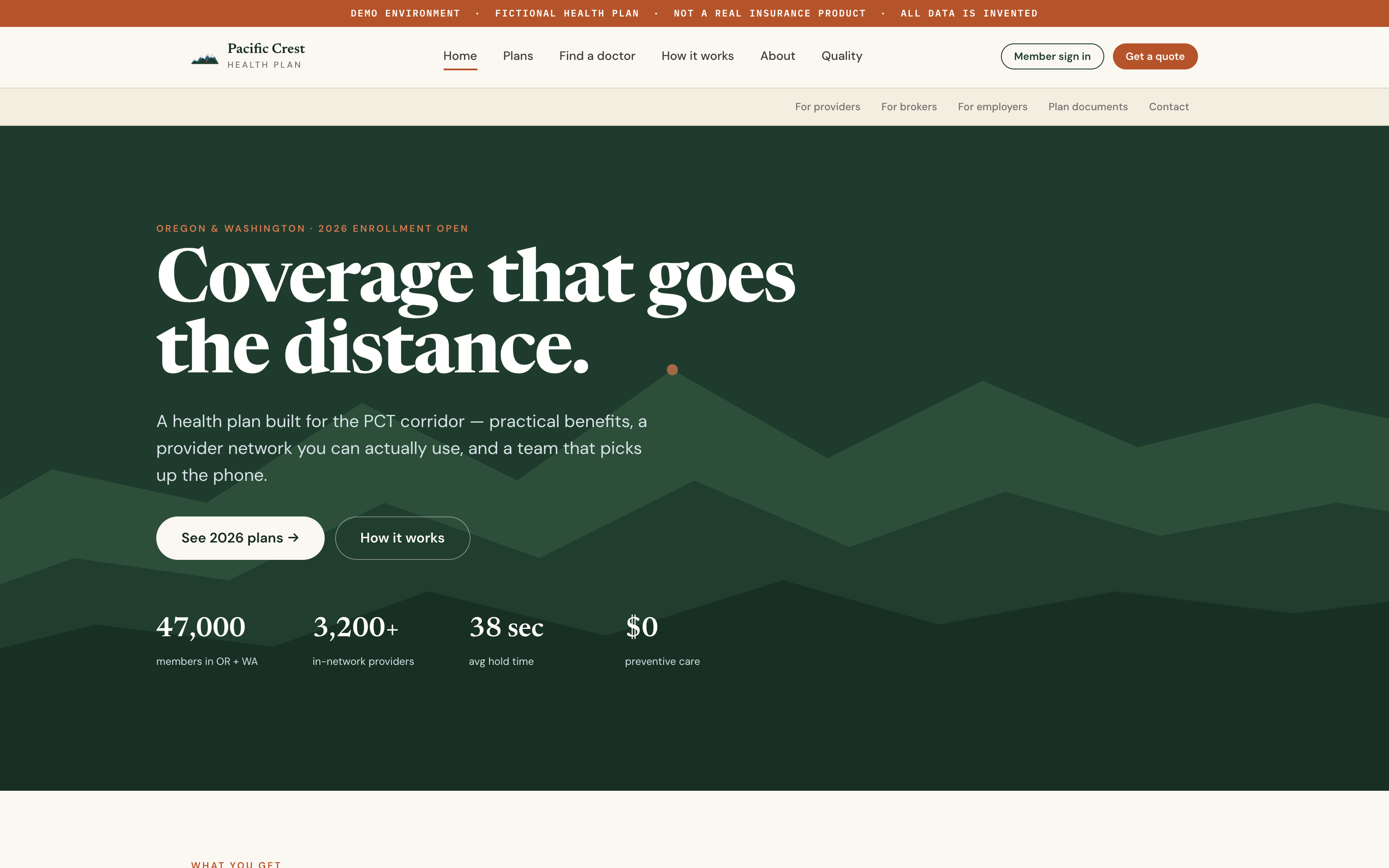
Pacific Crest Health Plan
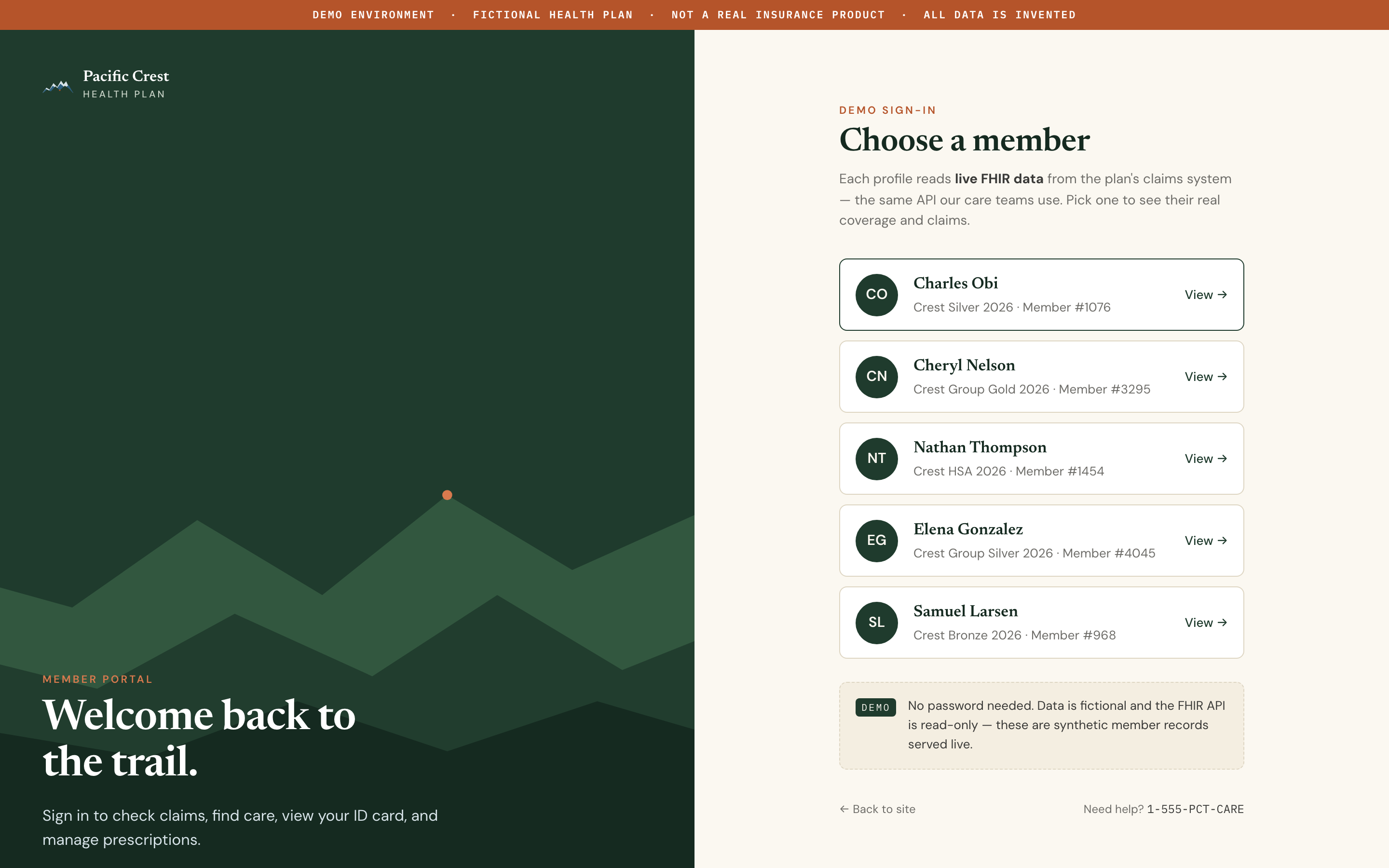
Flagship multi-LOB brand for most Accelerator demos: commercial, Medicare Advantage, and Medicaid-oriented storylines under one crest. Marketing (home, plans, providers, about) plus member portal (dashboard, claims, find care, ID card, pharmacy, messages). Static Vue + Tailwind with an S3/CloudFront/CDK path when we need real hosting. Demo login for presentations. Carrier name shows up in CIM lab and Iris fixtures as the default tenant narrative.
Camas Coordinated Care
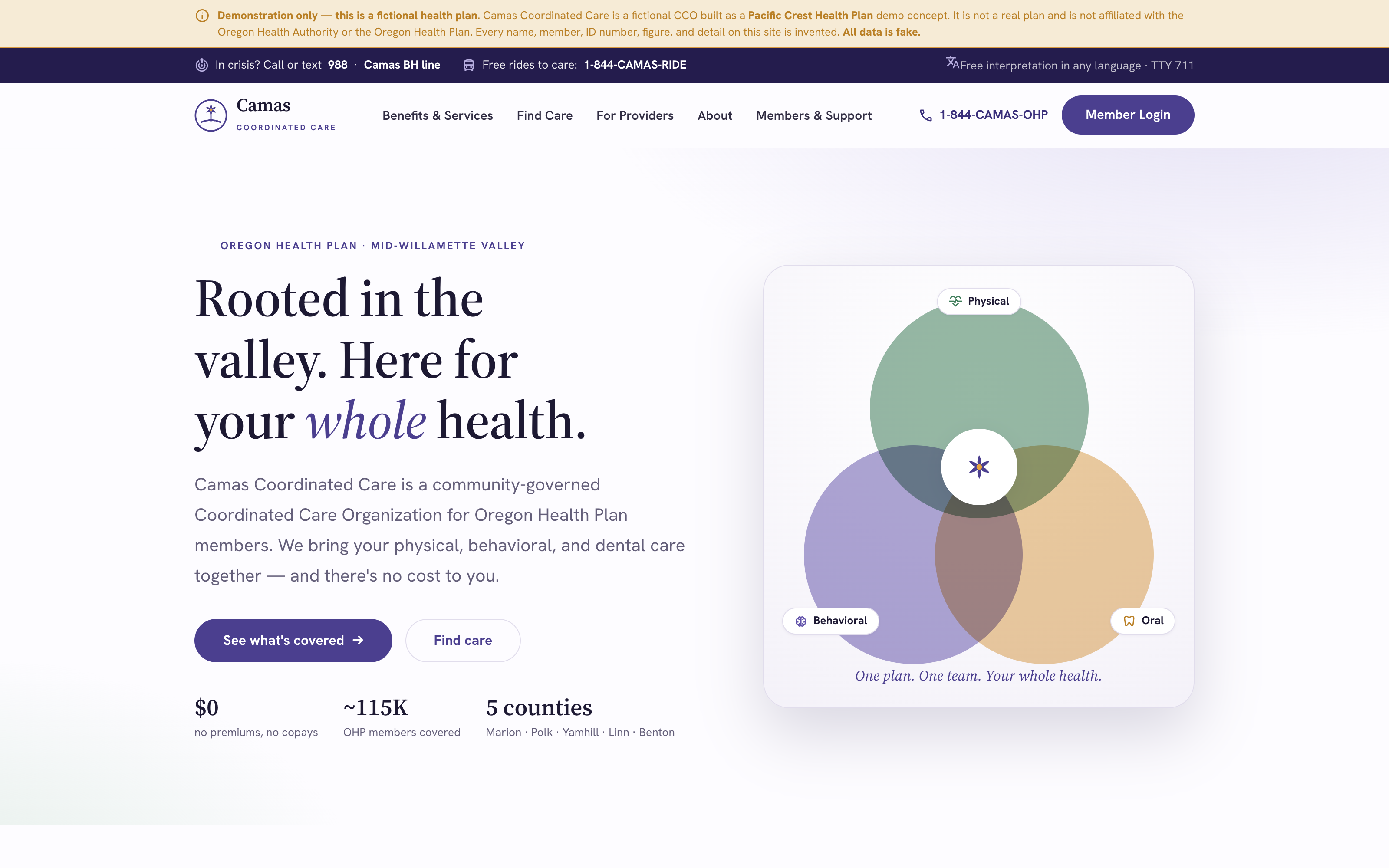
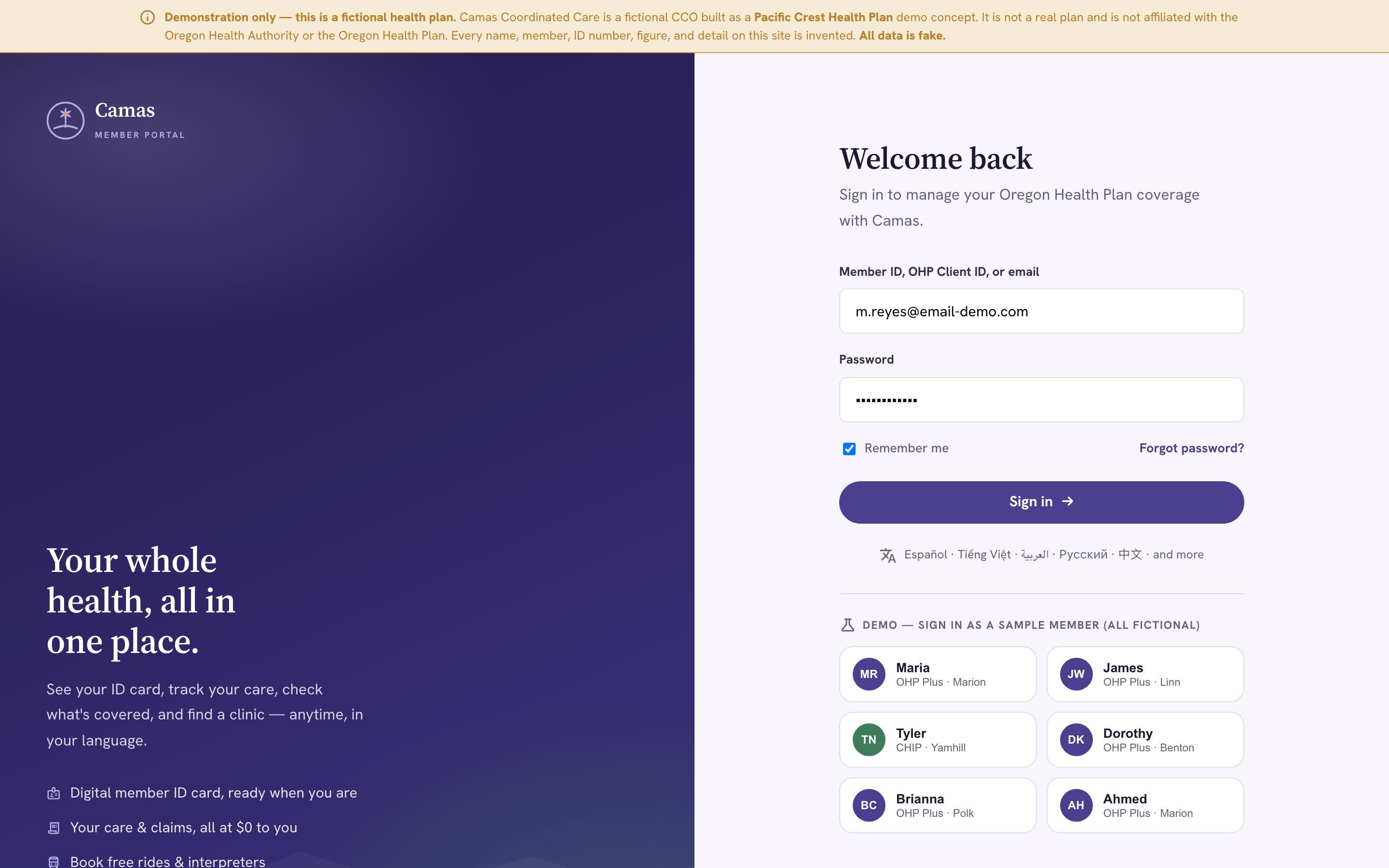
Oregon Medicaid CCO front door: whole-person care (physical, behavioral, oral, pharmacy, NEMT, community supports) with an explicit $0 member cost model. Vue 3 + Vite SPA from design handoff: camas-violet brand, six OHP/CHIP personas (prenatal, behavioral health, tribal care, and more), marketing pages, and portal (dashboard, care & claims, benefits, ID card, documents). Lives in the Pacific Crest universe as a demo concept, with a site-wide fictional-plan banner so nobody confuses it for a real CCO.
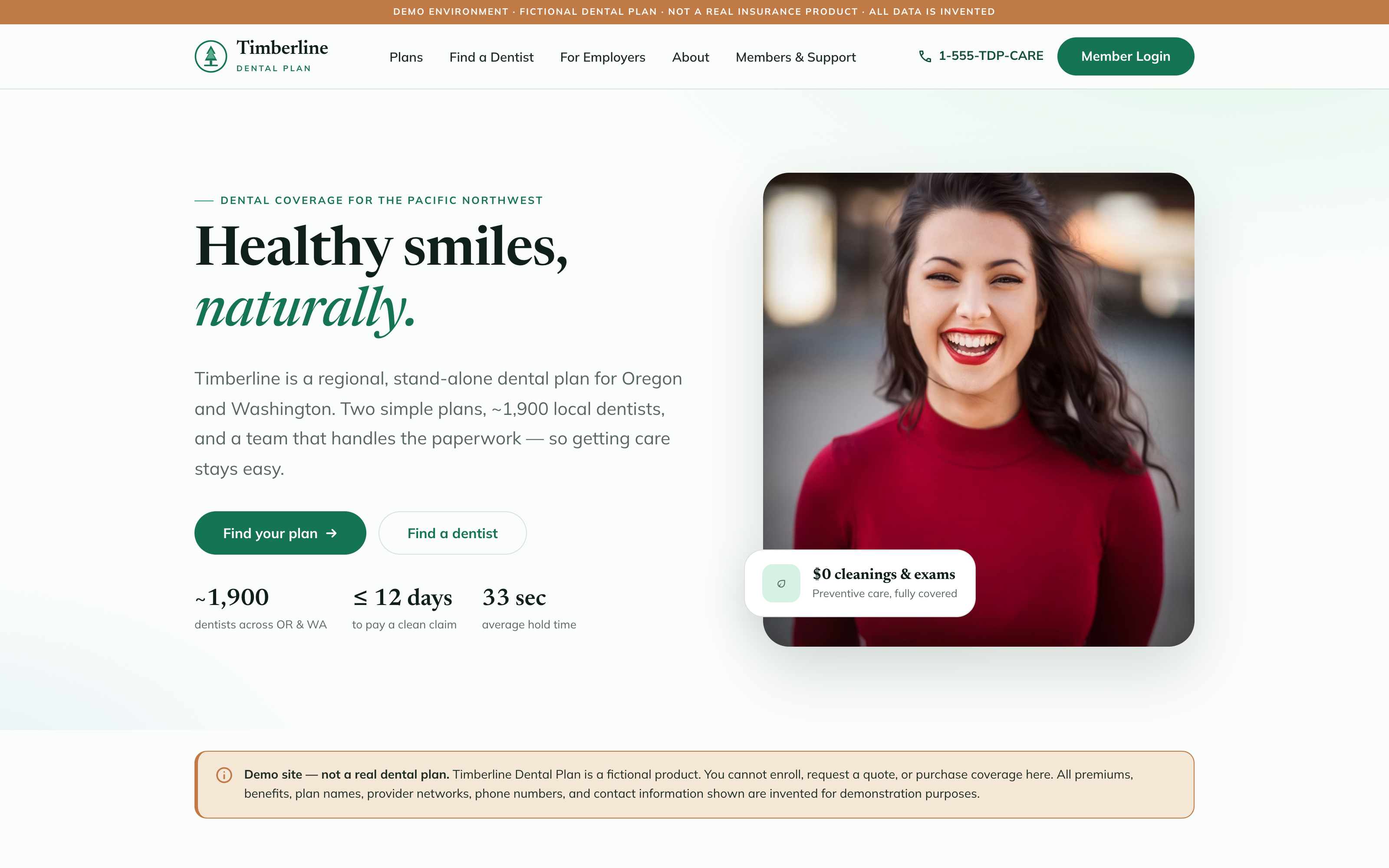
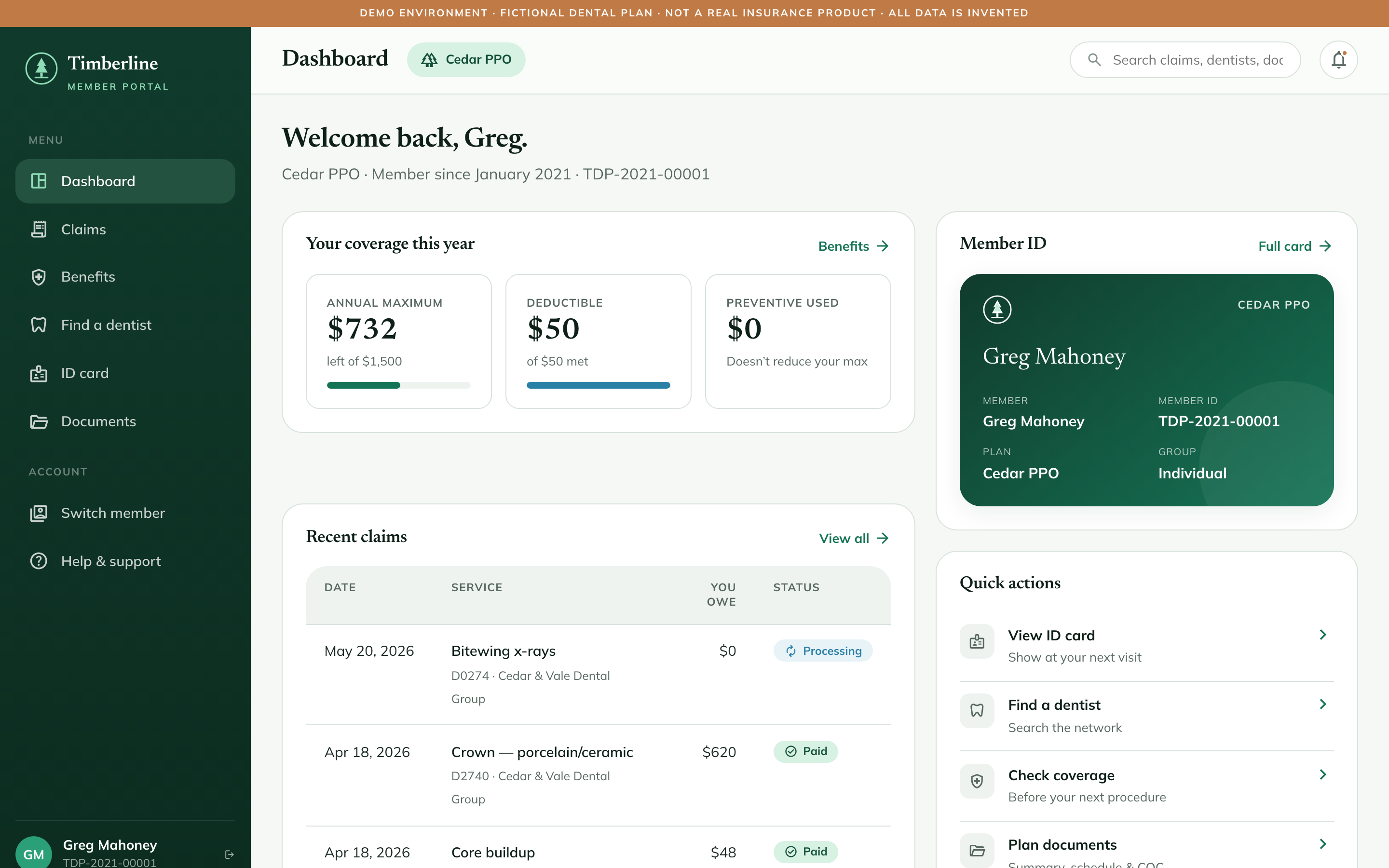
Timberline Dental Plan
Regional dental for Oregon and Washington. Stand-alone dental is usually underserved by medical brands in demos, so I gave it its own face. Vue 3 + Vite marketing (home, plans & pricing, find a dentist, about, members, brokers) and portal (personas, dashboard, claims, benefits, find dentist, ID card, documents). Six sample members with PPO vs DHMO views. Aligns with the generator’s timberline persona (CDT codes, predeterminations, dental claims).
Shared design principles
- Always-on demo ethics: banners and copy say fictional plan, invented data, not a real insurance product. Safe for screenshots and external portfolio.
- Marketing + portal pair: every brand has a public story and a member shell so demos can start outside ops tools.
- Persona switchers: multiple members per brand so walkthroughs span aid categories and LOBs without rebuilding fixtures mid-demo.
- One synthetic spine: Data Generator → FHIR API → portals + CIM lab, with wiki plan docs for narrative and RAG demos.
Results
- A reusable synthetic plan-brand program (medical multi-LOB, Medicaid CCO, dental) instead of one-off lorem carriers.
- Data Generator and Wiki got a member-facing counterpart: populations and plan docs have a place members “live.”
- Member portals and the CIM lab on the same FHIR path, so demos exercise full claim/member workflows rather than static mocks.
- Coherent demos across CIM lab, Iris, AI Claims, and enablement sessions with zero real PHI.
- Three production-quality Vue sites suitable for live walkthrough and static deploy patterns.
Why this still matters
Synthetic data without a story is just empty rows. When portals, CIM, Iris, and wiki docs share one invented plan world, demos stay honest (no real PHI) and people in the room can follow a member from “login” to ops work without context switching.
Related work
The Data Generator emits the persona datasets and FHIR/connector packs. Ayin Wiki holds synthetic plan documents. CIM UX laboratory consumes the same universe for ops-density experiments. Demo tenants only. Never production payers.
Stack
Vue 3 · Vite · Vue Router · Tailwind (PCHP) · static/CDN + CDK (PCHP) · FHIR-based API · Ayin Data Generator · Ayin Wiki